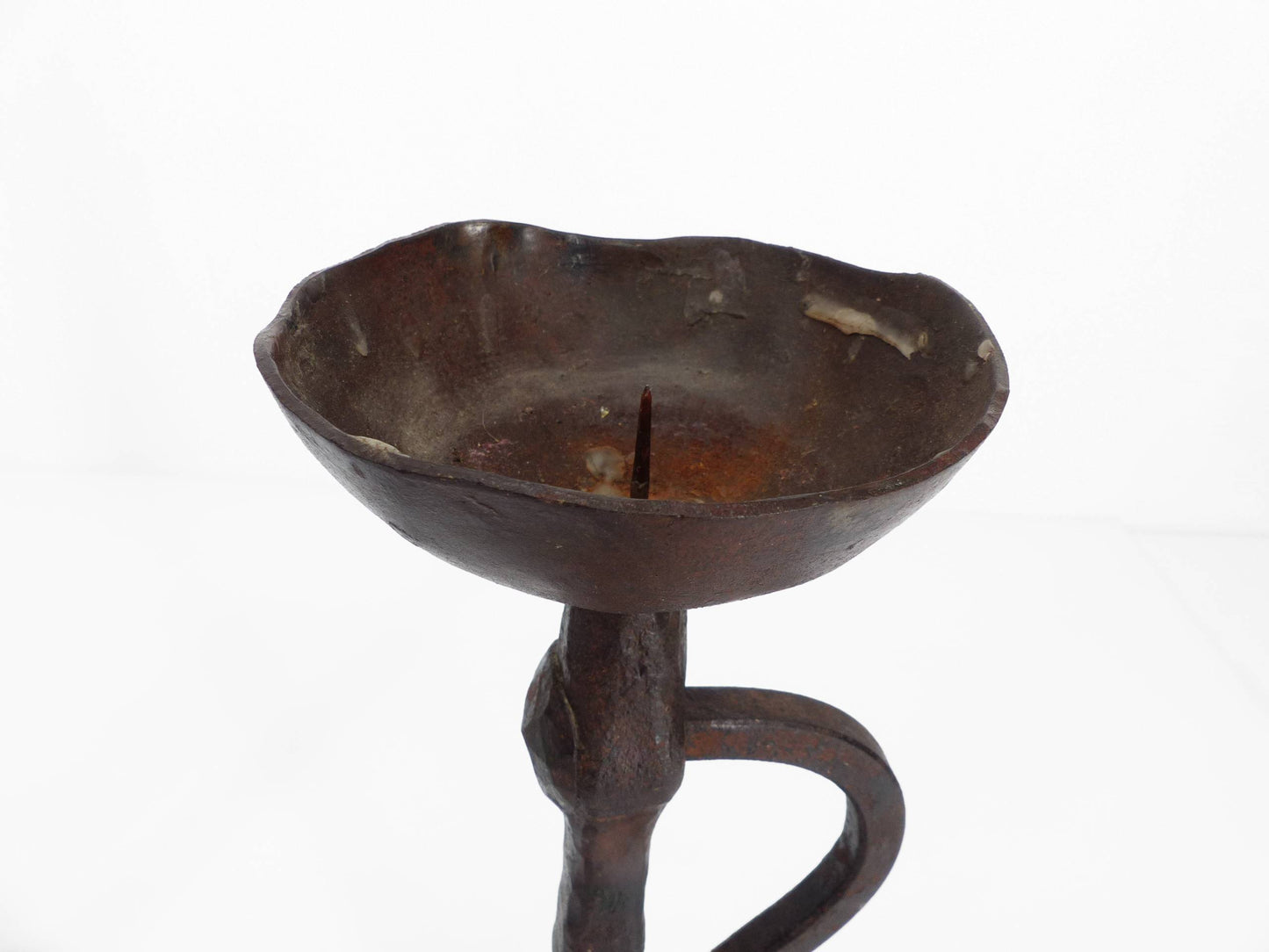
This pair of wrought iron candlesticks features a tripod structure entirely handcrafted, characteristic of French artisanal ironwork. Each piece rests on three wide, flattened feet forming a stable base, extended by a hammered vertical stem whose irregularities bear witness to the direct work at the forge.
The upper part consists of a hammered cup designed to hold a centrally mounted candle (pricket), a traditional system used before the widespread adoption of molded candles. A lateral volute forms a decorative and structural handle, visually balancing the object's silhouette.
The ensemble evokes medieval forms reinterpreted in the decorative arts of the 19th and early 20th centuries. The simple lines, exposed forging, and robust volumes recall the tradition of church or castle chandeliers, widely revisited by French wrought iron artisans in historicist or regionalist style interiors.
The Neo-Gothic style experienced a revival in Europe from the 19th century onwards, particularly in architecture and decorative arts. Wrought iron craftsmen drew inspiration from medieval forms – tripod legs, pricket cups and forged scrolls – to create decorative objects for bourgeois residences, country houses or Neo-Medieval settings.
These candlesticks illustrate this artisanal tradition where the utilitarian function is combined with expressive and sculptural forging work.
Technical details
• Designer: unidentified
• Manufacturer: artisanal metalwork workshop, France
• Period: early 20th century (stylistic estimate)
• Materials: wrought iron
• Finish: Dark brown antique patina with natural oxidation
Dimensions
• Height: 32 cm (12.6 in)
• Width: 20 cm (7.9 in)
• Depth: 20 cm (7.9 in)
• Weight (pair): 4 kg
State
Good overall condition. The iron has an old patina with even surface oxidation. Traces of use and wax residue are visible in the cups. The structure is stable; no restoration has been observed.
REF
NBR00326